History & Design
Established in 1985, the Chinese Cultural Garden was a gift of the city of Tapei and its business community and was modeled after the Chinese Imperial Palace. A plaque acknowledging the gift says: “On behalf of the people of Taipei We present this Chinese Cultural Garden to the people of Cleveland as a confirmation of friends and cultural exchange between our sister cities.”
The Chinese Cultural Garden embodies the complexities of Chinese history in the 20th century. After its civil war ended in 1949, China was split between the People’s Republic of China (which control’s mainland China) and the Republic of China (which controls Taiwan and several surrounding islands.)
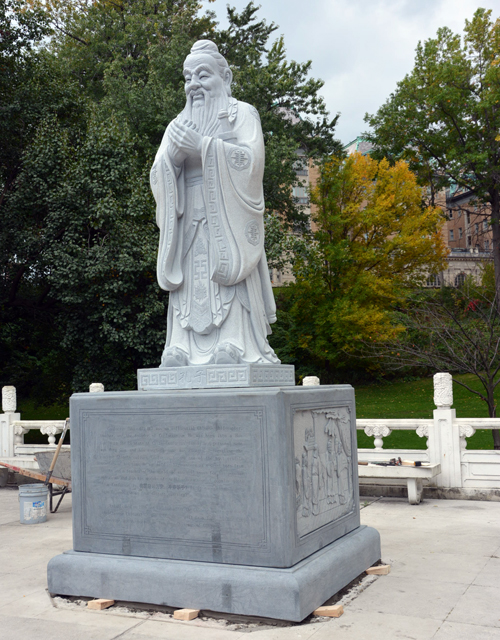
Geographically distant from the main chain of Cultural Gardens, the Chinese Garden is notable for the contrast of its stark white marble against a lush green background. Two Chinese dragons guard the entrance with a statue of Confucius (a teacher, philosopher and political theorist, 551-479 BC) atop a white pedestal.
(courtesy of the Cleveland Historical team at Cleveland State University).
中 國 文 化 公 園 The Chinese Cultural Garden: A Symbol of Heritage and Friendship

Established in 1985, the Chinese Cultural Garden in Cleveland, Ohio, stands as a tribute to Chinese heritage, culture, and international friendship. Located at Martin Luther King Blvd. & Nord Family Greenway, it remains one of the city’s most accessible and prominent cultural landmarks.
The garden’s creation was championed by Anthony Yen (嚴雲泰 先生). a Cleveland businessman and founder of the Chinese Cultural
Garden Association. Yen, a respected leader in global business and cultural affairs, discovered the garden’ s original design in Taipei City Hall. Initially planned for Kansas City, Missouri, he envisioned bringing it to Cleveland and successfully negotiated the relocation with Dr. Ling, Chairman of Dau Dung Co. and Taipei’s City Council President.
The garden was gifted by the City of Taipei and its business community to Cleveland as a symbol of cultural exchange. However, Taipei could not cover shipping or installation costs, leaving Yen to personally raise funds for transportation. When the materials arrived, they remained in storage at the Cleveland Port Authority for years due to disputes over the garden’s location. At the time, Cleveland’s cultural gardens were predominantly European, leading to opposition. Yen, along with Dr. Alex Mark, Frank Ngo, and architect Thomas Aung, lobbied for its inclusion.
With support from Mayor George Voinovich and Rabbi Silver, a site was secured near the Cleveland Museum of Art, home to an extensive Chinese art collection. The garden was officially incorporated as a 501(c)(3) non-profit organization to oversee its maintenance and development.
Later, Eddie Ni ( 倪舉凌 先生),a Chinese-American entrepreneur, became involved under Yen’s mentorship. Recognizing the garden’s importance, Ni played a key role in restoring the Confucius statue, which had suffered vandalism and deterioration. A 25,000-pound granite statue, commissioned from Shanxi, China, was installed, reaffirming the garden’ s significance.
Today, the Chinese Cultural Garden showcases elements of Imperial Chinese architecture, including white marble railings, symbolic statues, and lush greenery. The entrance, flanked by two Chinese dragons, leads to the Confucius statue, the garden’s focal point.
Under the continued leadership of Eddie Ni, the garden remains a hub for community gatherings, cultural exchange, and educational programs. Events like One World Day celebrate Chinese contributions to Cleveland, ensuring that the garden’s legacy of peace, cooperation, and heritage endures for future generations.